NextG cellular networks continue to grow in architectural complexity, particularly with the rise of flexible functional splits—techniques that partition the protocol stack between centralized units (CUs), distributed units (DUs), and remote radio units (RUs). These systems span heterogeneous deployments including millimeter-wave, sub-6 GHz, and satellite links, each with distinct characteristics and performance requirements. Developing, testing, and debugging such intricate systems is challenging and requires high-fidelity digital twins that can accurately emulate network behavior at scale. However, existing simulation solutions have fundamental limitations: many rely on specialized hardware accelerators that are expensive and unavailable to most researchers, while others provide only limited fidelity or cannot model the full protocol stack. This gap between simulation accessibility and fidelity has become a significant bottleneck for nextG network innovation and testing.
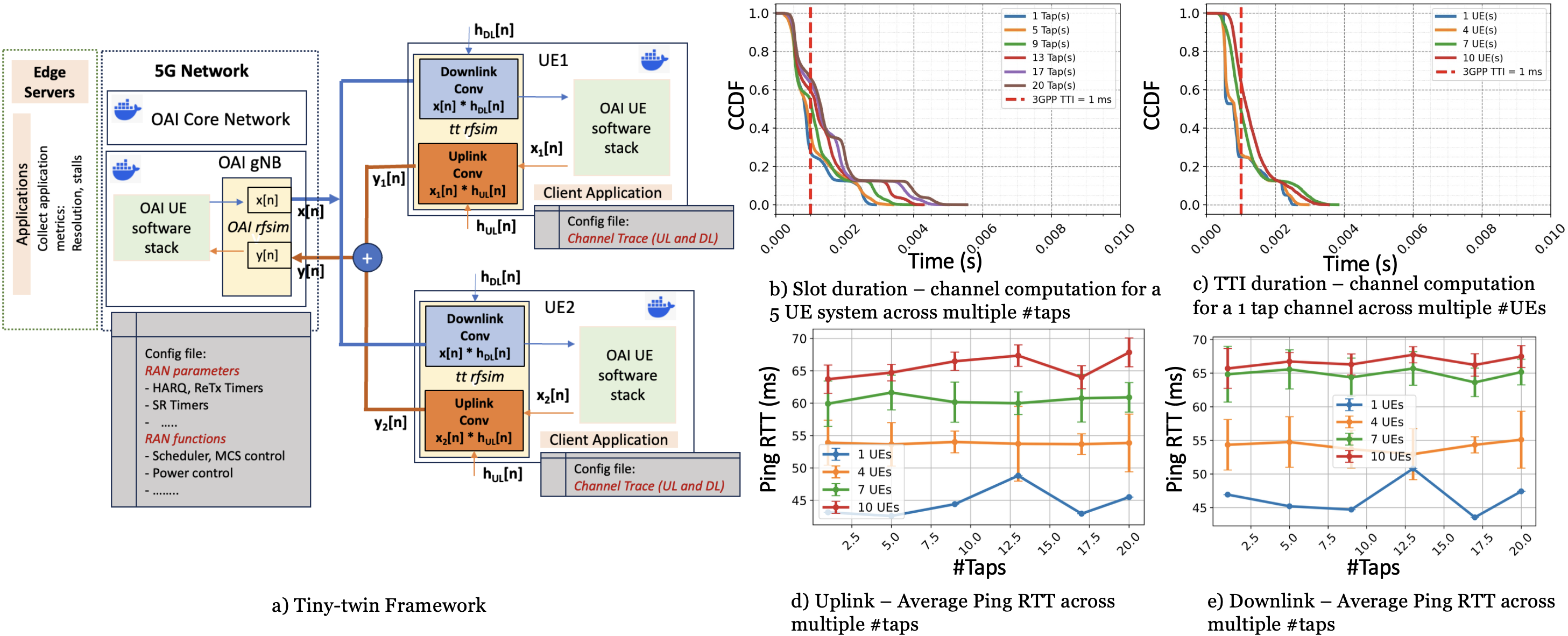
Tiny-Twin addresses these challenges head-on by providing a CPU-native, full-stack digital twin platform purpose-built for NextG cellular networks. Our key innovation is enabling accurate, full-stack simulation of complete network protocols—from physical layer through MAC and RLC to higher layers—while running efficiently on standard computing hardware without specialized accelerators. Tiny-Twin supports multiple functional splits (including split-7.2 and split-8), diverse network topologies, and heterogeneous deployment scenarios. The system is architected to handle realistic traffic patterns, mobility events, and channel conditions while maintaining simulation fidelity. Our extensive evaluation on a real-world O-RAN compliant testbed demonstrates that Tiny-Twin achieves near real-time simulation performance across diverse scenarios—including multi-user environments, high-speed mobility, congestion conditions, and degraded signal scenarios—while accurately predicting network behavior. This makes Tiny-Twin an accessible, practical tool for researchers, developers, and operators to rapidly prototype, validate, and optimize algorithms before deployment to live networks.
|
|