The IEEE 802.11mc Fine Timing Measurement (FTM) protocol has been deployed for several years, promising dedicated two-way-ranging support for Wi-Fi localization. We find that commercial FTM implementations significantly under-perform expectations when deployed in indoor settings. Out-of-the-box FTM consistently overestimates the true range by as much as 2–3 times in indoor environments. We observe that this problem is due to wi-fi receiver hardware not accounting for multipath reflections when it calculates its timestamp. To address this problem, we develop a simple channel impulse response (CIR) super-resolution algorithm which is able to accurately pick out the direct-path propagation delay from many overlapping reflections. We use this to develop an indoor localization
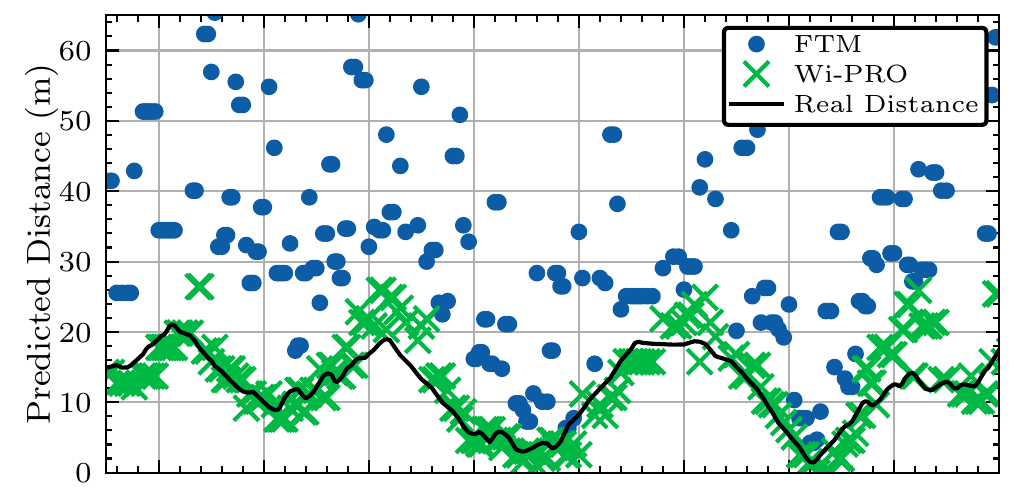
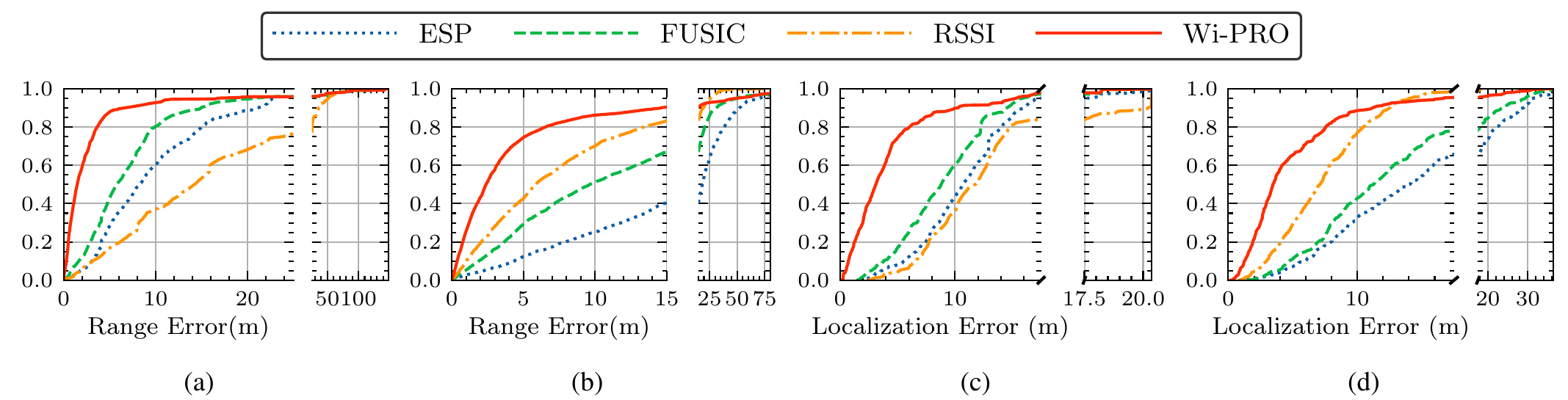
Using single-shot range measurements with no averaging or outlier rejection, Wi-PRO achieves a median ranging error of 1.51 m on DS1 and 2.39 m on DS2, a 3–4× improvement over the ESP32's built-in FTM and significantly better than the state-of-the-art FUSIC correction. With standard trilateration, Wi-PRO reaches 3–4 m median localization error, a 2–3× improvement over the base ESP32 ranges. Wi-PRO runs in real time on a standard 6$ ESP32-S3 dev board. All code and data are open-sourced.
|
|